Asphalt Crack Sealing in Dallas, TX
Hot-pour rubberized sealant for cracks a quarter inch to an inch wide. It's the cheapest repair in paving, and it prevents most of the expensive ones.
What crack sealing is
We melt rubberized asphalt sealant to about 380 degrees and pour it into a cleaned crack. It cools into a flexible plug that sticks to both sides. When the pavement shrinks in winter and the crack opens, the sealant stretches. When summer closes the crack, it squeezes back.
That flexibility is the point. Cold-pour filler from a jug goes hard, cracks and lets go within a season.
Which cracks can be sealed
Size decides it. Cracks under a quarter inch are too narrow to take sealant, and a sealcoat handles those. Cracks from a quarter inch to an inch are what crack sealing is for. Over an inch, the crack needs a hot mix patch.
Pattern matters too. Long single cracks seal well. Alligator cracking, the tight grid of small squares, can't be sealed at all, because the base under it has failed. That needs a full-depth patch.
Why fall is the best time
Pavement shrinks as it cools, so cracks are narrow in August and wide in January. Sealant placed in mild weather sits at the middle of that range and can move both ways. Sealant squeezed into a crack on a 100 degree day tears when the crack opens that winter. In Dallas the best windows are October to early December and March to April.
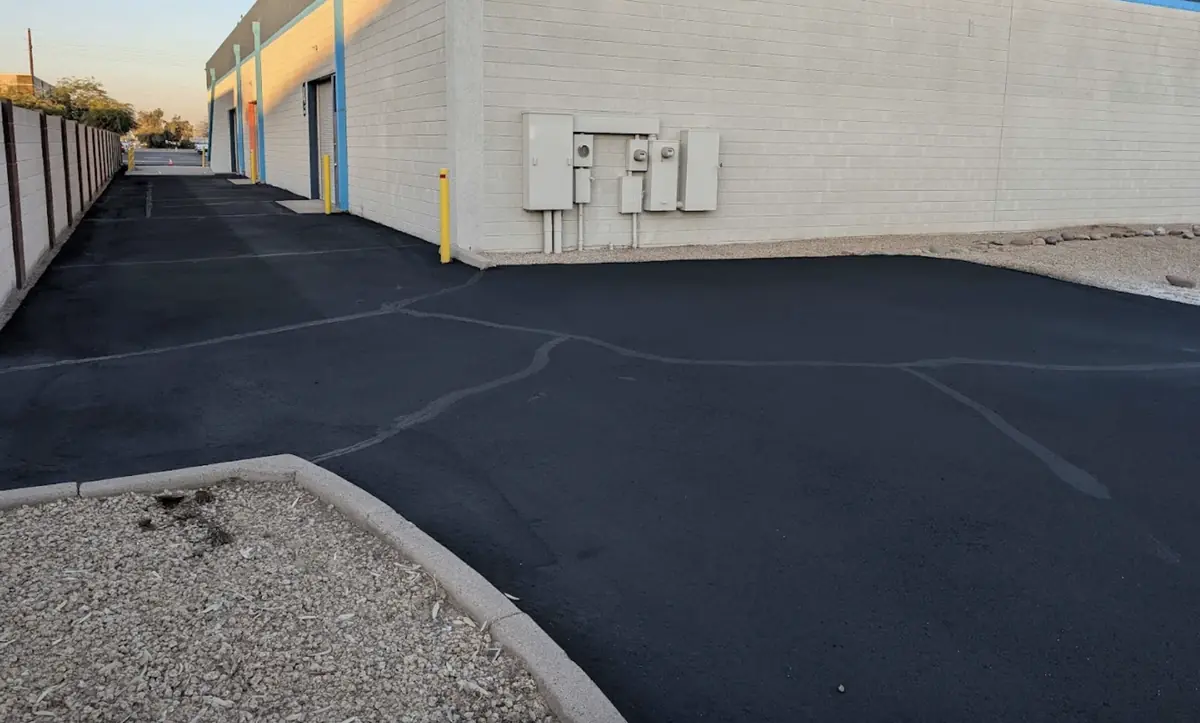
How we seal cracks
- Rout where needed. On cracks that open and close a lot, we cut a small reservoir along the crack, about half an inch wide and half an inch deep. It gives the sealant a shape that can stretch.
- Clean and dry. Compressed air blows out dirt, weeds and loose stone. Damp cracks get dried with a heat lance, because sealant won't stick to wet asphalt.
- Pour. Sealant goes in from the bottom up and is leveled with a narrow squeegee, leaving a thin band about 2 inches wide over the crack.
- Open to traffic. The sealant sets in 30 to 60 minutes. On hot days we dust it with sand so it doesn't track onto tires.
Why Dallas pavement cracks along the edges
The clay under Dallas pavement shrinks through a dry summer and pulls away at the perimeter. That's why the long cracks on a lot so often run parallel to the edge, a few feet in. Left open, each one channels storm water straight down into the base, and the clay swells unevenly the next spring.
Sealing those edge cracks every few years does more for a Dallas lot than any other maintenance. It keeps the base dry, and a dry base is what holds everything else up.
What it costs
Crack sealing typically runs $0.50 to $1.50 per linear foot, with routed cracks at the top of that range. A 20,000 square foot lot with moderate cracking has 750 to 2,000 feet of crack, so most jobs that size cost $750 to $2,500. Compare that with $4 to $7 per square foot to patch the potholes that open cracks turn into.
Crack sealing questions
Should cracks be sealed before sealcoating?
Yes. Sealcoat can't bridge a crack wider than a quarter inch. We seal the cracks first and sealcoat over them, which also hides the sealant bands.
How long does crack sealant last?
3 to 5 years for a standard pour and up to 7 or 8 for a routed crack. It depends on how much the crack moves between seasons.
Will I still see the cracks after sealing?
Yes. You'll see dark, slightly shiny bands where the sealant sits. A sealcoat afterwards blends most of them in.
Related pages
Cracks opening up?
We'll measure them by the foot and tell you which ones can be sealed and which need a patch.