Commercial Asphalt Paving in Dallas, TX
Truck courts, retail centers, church lots and private roads. Thicker sections where the loads are, night and weekend schedules, and tonnage tickets you can check.
Where commercial pavement fails
Commercial pavement breaks where heavy axles turn. Loading docks, dumpster approaches, drive-through lanes and the first 50 feet inside an entrance take the worst of it. We build those areas thicker than the stalls, and that's where most of the extra money goes.
Typical sections look like this. Car stalls get 6 inches of base and 3 inches of asphalt. Drive lanes get 8 and 4. Truck courts get 10 inches of base and 5 to 6 inches of asphalt laid in three lifts.
We'll also tell you where asphalt is the wrong material. A dumpster truck sets its front wheels in the same spot every week, and a parked trailer rests on two small steel feet. In summer heat asphalt dents under loads that sit still. Those spots should be concrete pads, and we include them in the quote.
You get paperwork you can file. That means a site plan showing each phase, the section thickness for each area, and delivery tickets from the asphalt plant showing tonnage. Tonnage is how you verify thickness. One ton of hot mix covers about 80 square feet at 2 inches.
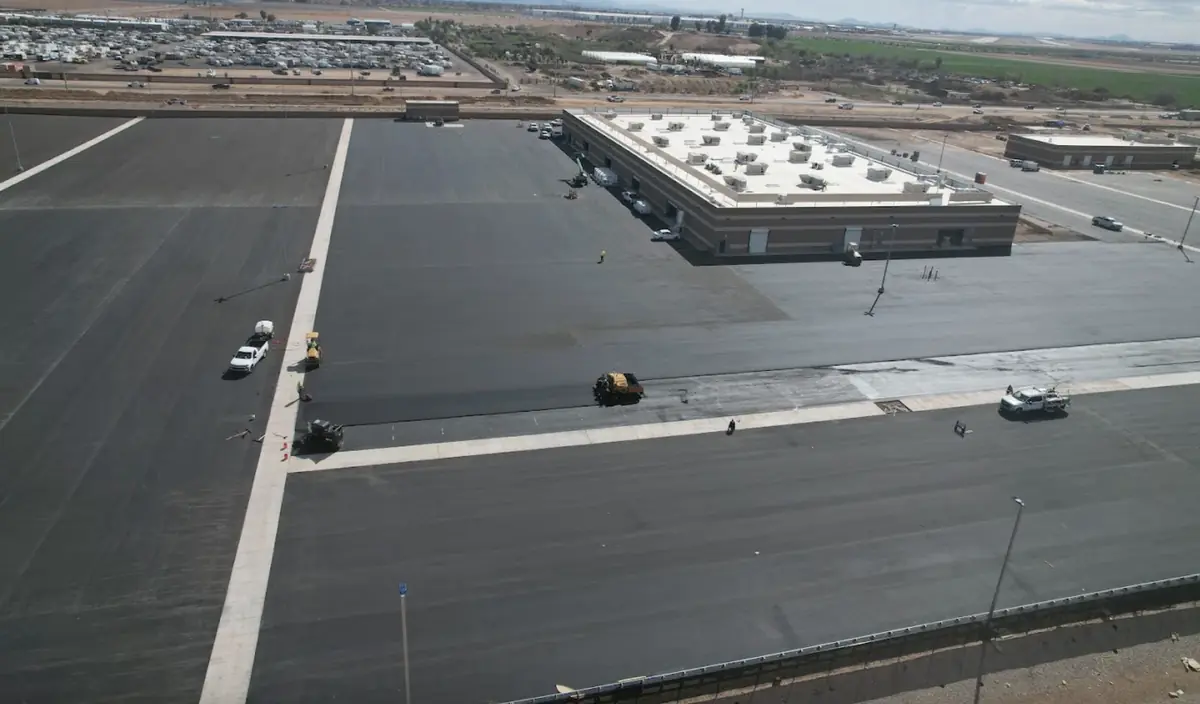
How a commercial job runs
- Walk the site and core it. We walk the property with you and cut two or three cores to see what's under the surface. A core shows the asphalt thickness and whether there's any stone base at all.
- Agree the phases. We draw up which areas close on which days. Tenants and delivery drivers get notice, and we set cones, barricades and flaggers where traffic has to be redirected.
- Remove and repair. Failed areas are milled or dug out. Soft subgrade is replaced or lime treated, and new base is compacted before any asphalt arrives.
- Pave, stripe, reopen. Each phase is paved, rolled and striped, then opened 24 hours later. We walk the finished job with you before the last barricade leaves.
Heat, clay and schedule
Two local conditions drive the spec. Summer pavement temperatures above 140 degrees call for stiffer binder in truck areas, PG 70-22 or PG 76-22. And the clay under most of Dallas County has to be kept dry and confined, which is what the base and the drainage slope are for.
Schedule drives the price almost as much. Night paving keeps a retail center earning, but asphalt plants charge to open after hours, and that usually adds 10 to 15 percent. Sunday work for offices and Monday to Thursday work for churches cost nothing extra.
What it costs
Heavy duty sections typically run $5 to $9 per square foot. Standard car parking runs $3 to $6. If the base is sound, a mill and overlay comes in at $2 to $4. Most commercial properties end up with a mix of all three, priced area by area. See the parking lot paving cost guide for worked examples.
Commercial paving questions
Do you pave at night?
Yes. We pave retail centers, restaurants and medical offices at night and reopen by morning. It costs 10 to 15 percent more because the asphalt plant charges to run after hours.
How do I know I got the thickness I paid for?
Check the plant tickets against the area. One ton covers about 80 square feet at 2 inches compacted, so 10,000 square feet at 2 inches should show around 125 tons. We hand over every ticket.
Do you pave private roads for HOAs?
Yes. Private streets usually get a 2 inch overlay after edge milling at the gutters. We work one lane at a time so residents can get in and out all day.
Related pages
Managing a property that needs paving?
Send the address. We'll core it, map it and price it area by area.